
A familiar companion to learn alongside.
Choose a companion from our characters and worlds to explain, invite practice and encourage reflection. Educators define the objectives, review the stories and guide their use.
1 · Explain an idea
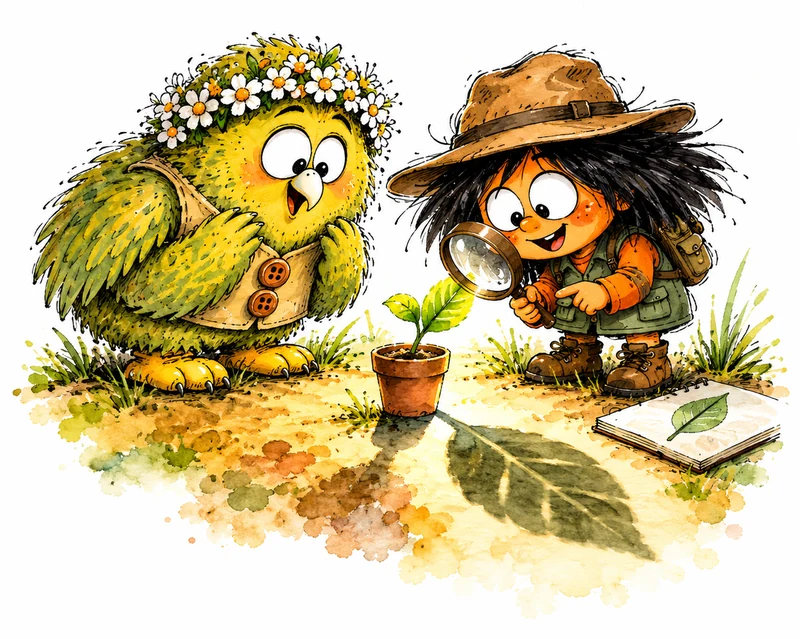
Poro and Aro observe a seedling: a familiar companion could introduce what plants need, using language and prompts reviewed by an educator.
Read the field-note text — Kākāpō
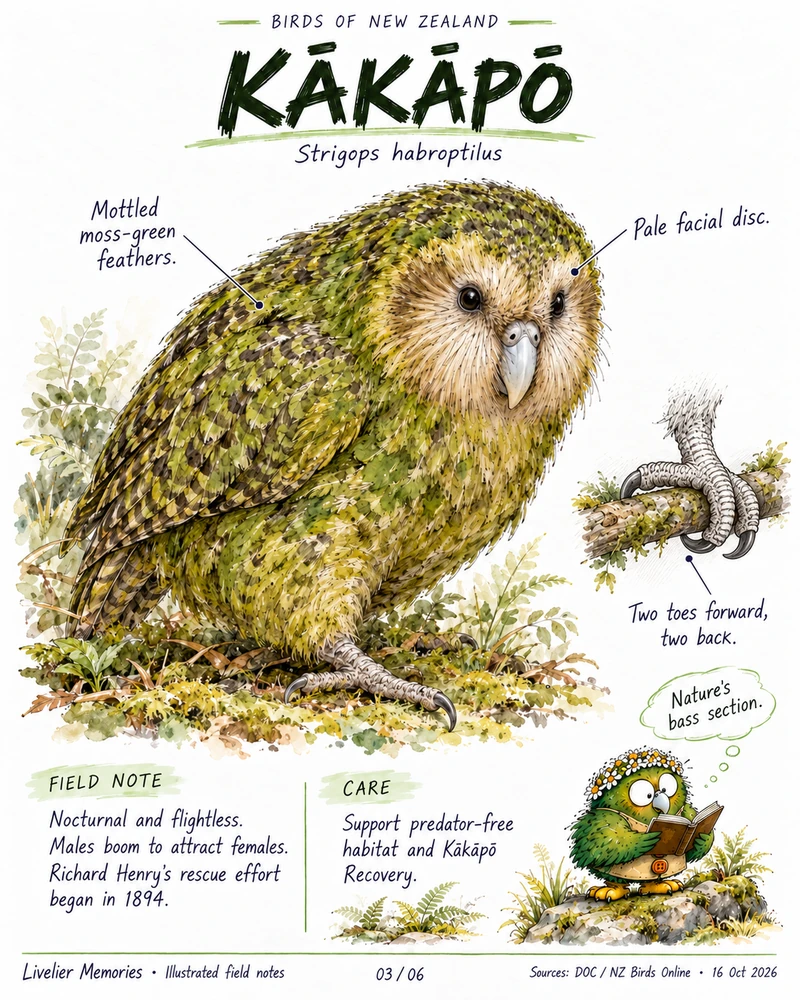
Kākāpō · Birds of New Zealand
Strigops habroptilus
An illustrated kākāpō stands among foliage. Labels identify its feathers and face. A separate foot illustration shows the toe arrangement. A small cartoon bird wearing a flower crown reads a book beside the field notes.
Labels
- “Mottled moss-green feathers.”
- “Pale facial disc.”
- “Two toes forward, two back.”
Field note
Nocturnal and flightless.
Males boom to attract females.
Richard Henry’s rescue effort began in 1894.
Care: “Support predator-free habitat and Kākāpō Recovery.”
Cartoon thought bubble: “Nature’s bass section.”
Livelier Memories · Illustrated field notes · Card 03 / 06.
Sources shown: DOC / NZ Birds Online · .
Selected facts checked against NZ Birds Online: Kākāpō, DOC: Kākāpō Recovery history and the NZ Birds Online reference (PDF).
Discovery and field-note cards
The same companion invites learners to notice, compare and practise describing what they see. Illustrated cards bring together observation prompts and checked facts; educators adapt the language, questions and format for age, accessibility and context.
Use cards in a museum, on a nature trail or in a guided activity. Local facts and conservation advice need an authoritative subject reviewer.
Stories that start an activity
A familiar character’s story gives learners something to reflect on: what did they notice, what changed and what might they try next? Educators shape the discussion and review factual and learning-design content.
Use reviewed story/activity assets on printed sheets, a workshop screen or a QR guide. The companion supports educators rather than replacing them or encouraging emotional dependency.
Participation stays optional, with no pressure on children to donate, buy or share personal data.
What we make
- A selected Livelier Memories character or world with agreed educational applications
- Current character, personality and visual references, with consistent language and tone
- Reviewed story and activity prototypes
- Agreed print and digital artwork with a review checklist
What you bring
- Audience, age range and accessibility needs
- The learning or participation objective
- Checked subject matter and source materials
- An educator or community reviewer
- Brand and character rights, and planned channels
We deliver digital content and artwork files. Physical printing, manufacturing and fulfilment are separate and must be arranged within an agreed scope.
These examples are our own samples and concepts, not claimed client deployments. Educators review learning design and subject accuracy before use.
Voice means consistent language and tone unless audio production is expressly scoped. Optional voiced or interactive concepts are agreed separately with education and technical partners. Human review, age-appropriate boundaries and accessibility guide the work; printing, facilitation, permissions and distribution are scoped individually.
Test the activity, not just the appeal.
Start with a focused objective and a baseline. Check whether people understand the intended idea, can complete the activity and choose to participate. Gather educator or facilitator feedback and record confusion or negative responses. Enjoyment and viewing time are not proof of learning.
These are concepts to evaluate, not promises of educational improvement.
Shape a character-led learning idea.
Scope, production and licensing are agreed individually by enquiry.